Security / GRC

Asset truth security teams can prove.

Give security and GRC teams a source-backed view of what exists, who owns it, where it lives, and whether it is covered.

Start with the covered, uncovered, and weakly-owned assets that shape a real security or audit scope conversation.
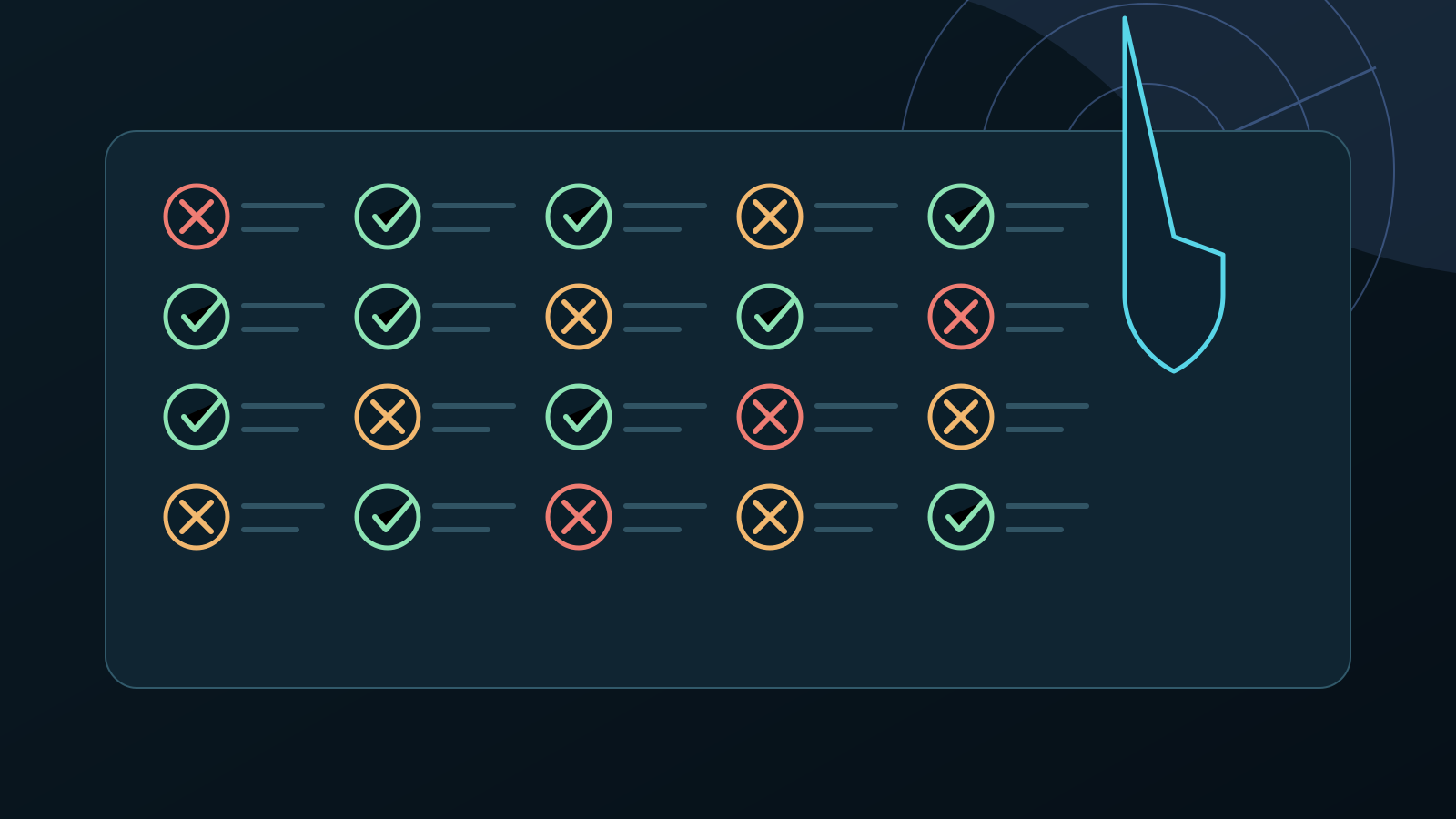
Coverage matrix showing protected, missing, and attention-needed assets.
Inventory What exists
Coverage What is protected
Ownership Who acts
Evidence What proves it

Control Scope

Where this helps security and GRC

VeridataOps reconciles endpoint, identity, cloud, network, vulnerability, monitoring, and inventory evidence so teams can defend scope, find uncovered assets, and route remediation to the right owners.

Know scope Define audit, vulnerability, and control scope from inspected source evidence.
Find gaps Identify assets without EDR, monitoring, ownership, lifecycle, backup, or vulnerability coverage.
Explain risk Tie findings back to evidence so remediation and audit conversations are easier to defend.

Use-Case Depth

What usually triggers this project

Trigger Security teams cannot defend audit or remediation scope across many overlapping inventory sources.
Trigger Coverage questions around EDR, monitoring, backup, vulnerability, or ownership are blocking action.
Trigger Assurance stakeholders need proof that findings map back to real estate evidence and named owners.

Typical Inputs

Typical inputs and sources

Input Endpoint, identity, monitoring, vulnerability, backup, cloud, and inventory-system evidence.
Input Business or ownership context needed to route remediation rather than just list exceptions.
Input Reviewed evidence that distinguishes true coverage gaps from noisy raw-tool discrepancies.

Example Workflow

Example security coverage workflow

Assemble the coverage viewCollect the sources that show what exists and which controls should apply.
Review uncovered or conflicting assetsInspect missing ownership, control gaps, and relation context before publishing a gap list.
Prepare the assurance readoutGroup findings into scope, owner, evidence, and next-action language that reviewers can defend.
Route the next proof stepDecide which sources, packs, or downstream systems should be added next.

Deliverables

What the buyer receives

Deliverable One reviewed coverage readout with protected, uncovered, and attention-needed assets.
Deliverable One evidence-backed owner and dependency story for the highest-risk exceptions.
Deliverable One next-step plan for remediation routing, scope expansion, or assurance follow-up.

Assurance Map

Coverage gaps surfaced from many sources

Security teams need to see where inventory, controls, ownership, and remediation responsibility diverge.

Coverage matrix showing protected, missing, and attention-needed assets.
Platform See how evidence becomes trusted estate context
Data Packs Review integration coverage
Security Read the access model
Contact Send a message

Next Step

Turn this solution page into a real evaluation path.

A detailed solution page should send the visitor to the matching proof, the workflow docs, and one scoped conversation instead of stopping at the use-case description.

Proof

Inspect the matching proof artifacts Use the proof library to anchor this workflow in inspectable product evidence. Browse Proof Library

Docs

Review the operating model Use the evaluation workflow page to show how evidence is collected, reviewed, committed, and published. Review Evaluation Workflow

Contact

Scope the next review Route the buyer to the use-case discussion only after the exact business pressure and implementation question are clear. Discuss This Use Case