Proof Library

Inspect the customer-safe proof artifacts a serious evaluation should leave behind.

This page collects bounded proof artifacts that can be shown publicly without claiming customer outcomes, certifications, or unsupported rollout promises. The goal is to show what a real evaluation produces: reviewed changes, evidence-linked records, coverage caveats, and deployment references.

Use a scoped walkthrough when you want to inspect the evidence boundary before discussing rollout.

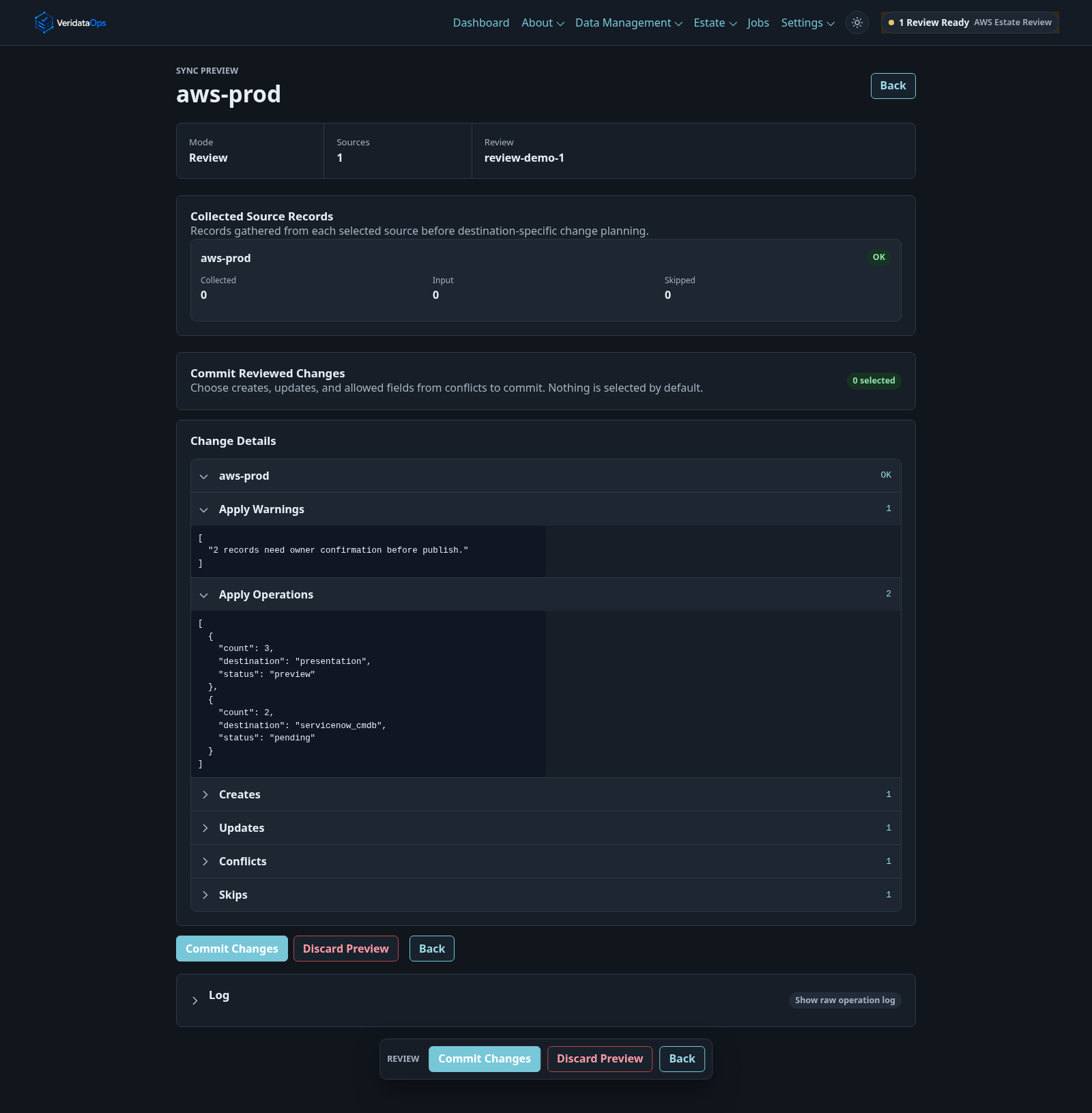
Real VeridataOps review workflow screenshot showing grouped changes and destination operations before approval.

Proof Artifacts

Inspect bounded artifacts instead of reading one more product description.

Each panel below is structured like a public-safe evaluation artifact: what the reviewer sees, what it proves, and what caveat still applies before a customer or audited scope can rely on it.

Artifact 01

Real VeridataOps review workflow screenshot showing a saved preview with apply warnings, pending publish operations, and grouped creates, updates, conflicts, and skips.
Reviewed change excerpt

A saved preview with creates, updates, conflicts, skips, and destination operations before any approval step.

What this proves Shows that the operator can inspect downstream impact before the next estate state or destination publish is accepted.
Caveat Row counts, destination names, and object identifiers are redacted here because the public goal is to prove workflow shape, not customer scope.
Redacted proof sample
Preview: saved review before commit
Creates: 14 Updates: 9 Conflicts: 2 Skips: 3
Destination actions: ServiceNow CMDB publish queued
Operator note: security-group relationship requires review
Open the related workflow

Artifact 02

Real VeridataOps Evidence Explorer screenshot showing a virtual machine record, related database and security group dependencies, and workflow readiness details.
Evidence-linked record excerpt

One record view with source IDs, relationship paths, readiness signals, and publish actions still tied to source evidence.

What this proves Shows that reviewers can explain why one record changed, which dependencies are affected, and what source evidence still supports the decision later.
Caveat Hostnames, account IDs, network ranges, and dependency names are intentionally masked in the public sample.
Redacted proof sample
CI type: Virtual machine
Evidence source: AWS + monitoring pack
Linked relations: database, security group, business service
Readiness: publish blocked until ownership field confirmed
Open the related workflow

Artifact 03

Real VeridataOps data pack builder screenshot showing pack identity, input and authentication settings, capabilities, and semantic mapping sections.
Coverage and caveat note

One short summary of supported packs, source limits, collector reach, and remaining gaps that still need scoped implementation work.

What this proves Shows that the first proof includes fit limits and follow-up work instead of pretending that source support alone resolves deployment questions.
Caveat This sample is product-safe because it documents evaluation limits rather than naming a customer deployment boundary.
Redacted proof sample
Source tested: private-network Active Directory via collector
Pack scope: identities, groups, organizational units
Limit noted: no entitlement publish decision in first session
Follow-up: confirm destination contract for ServiceNow CMDB
Open the related workflow

Artifact 04

Real VeridataOps review workflow screenshot used as a public-safe reference to reviewed product state and workflow evidence.
Deployment reference note

One reference to the reviewed product version, component images, and the next deployment decisions still required for the audited or customer-facing scope.

What this proves Shows how technical proof becomes a deployment-fit discussion without implying automatic rollout, compliance approval, or contract closure.
Caveat The public sample names the shape of the deployment reference, not a customer environment or certification result.
Redacted proof sample
Reviewed version: vRELEASE public build
Control plane: shared SaaS evaluation path
Collector boundary: outbound-only customer-side runtime
Next decision: dedicated, managed, or OEM scope required?
Open the related workflow

What The Reviewer Keeps

A serious evaluation should leave a reusable artifact set behind.

The first proof should produce evidence a technical evaluator or sponsor can revisit later, not just a memory of the walkthrough.

Reviewed change excerpt A saved preview with creates, updates, conflicts, skips, and destination operations before any approval step. Shows how operators inspect impact before downstream systems inherit the next state.
Evidence-linked record view One record view with source IDs, relationship paths, readiness signals, and publish actions still tied to source evidence. Shows how reviewers explain what changed and what depends on it later.
Coverage and caveat readout One short summary of supported packs, source limits, collector reach, and remaining gaps that still need scoped implementation work. Shows that the first proof includes limitations, not just optimistic claims.
Deployment reference note One reference to the reviewed product version, component images, and the next deployment decisions still required for the audited or customer-facing scope. Shows how technical proof transitions into a deployment decision without implying automatic rollout.

Claims Register

Keep proof tied to tested product behavior.

A public proof library still has to explain what is implemented, what is scope-dependent, and where caveats remain.

Evidence collection tested product capability: Source packs and customer-network collectors collect raw source payloads, source timestamps, runtime logs, and mapping output for review. Coverage depends on the installed data packs, source credentials, network reachability, collector version, and customer-approved collection scope.
Review before current estate tested product capability: Collected evidence enters a review workflow before selected rows are committed into tenant current estate records and cache indexes. Rejected or uncommitted evidence remains audit evidence and must not be presented as current estate truth.
Collector execution tested product capability: Collectors run near private systems, call home outbound over HTTPS/WSS or polling, lease scoped jobs, and report version/log/status telemetry. Collectors can only reach systems available from their network zone and should be kept on a compatible published image.
Estate relationships and confidence evidence-backed semantic capability: Data packs declare semantic objects, identity keys, relationship contracts, source metadata, and confidence/correlation guidance. Cross-source matches are confidence-based. IP-only, name-only, and proxy/relay observations need caveats when no stronger identity evidence exists.
Customer-facing reports release-gated claim: Reports must be generated from committed estate evidence, release evidence, and scoped audit records, not from raw unreviewed source payloads. Each report must name the tenant/environment, product version, evidence date, known limits, and open work-item caveats.
Compliance support scope-dependent support statement: Product controls can support ISO/IEC 27001, NIST CSF, PCI-sensitive, GxP, SOC 2, GDPR, DORA, and supply-chain readiness discussions through evidence and release records. Do not claim VeridataOps is ISO certified, GxP validated, Part 11 compliant, or PCI compliant unless a formal audited scope has achieved and approved that statement.

Next Step

Turn proof panels into a concrete review path.

After a visitor inspects the artifacts, the site should push them to the workflow docs, coverage review, or technical walkthrough that matches what they just saw.

Docs

Read the workflow behind the artifact Use the evaluation workflow doc to explain how the proof sample is collected, reviewed, and published. Review Evaluation Workflow

Coverage

Check modeled source fit Use the coverage hub when the next question is whether the relevant source or destination path exists today. Open Coverage Hub

Contact

Request the technical walkthrough Start the walkthrough only after the reviewer can point to the exact artifact and follow-up question. Request Technical Walkthrough